

Home < ENGINEERING WISDOM < Education Series <
Engineering Wisdom | 16 October 2026
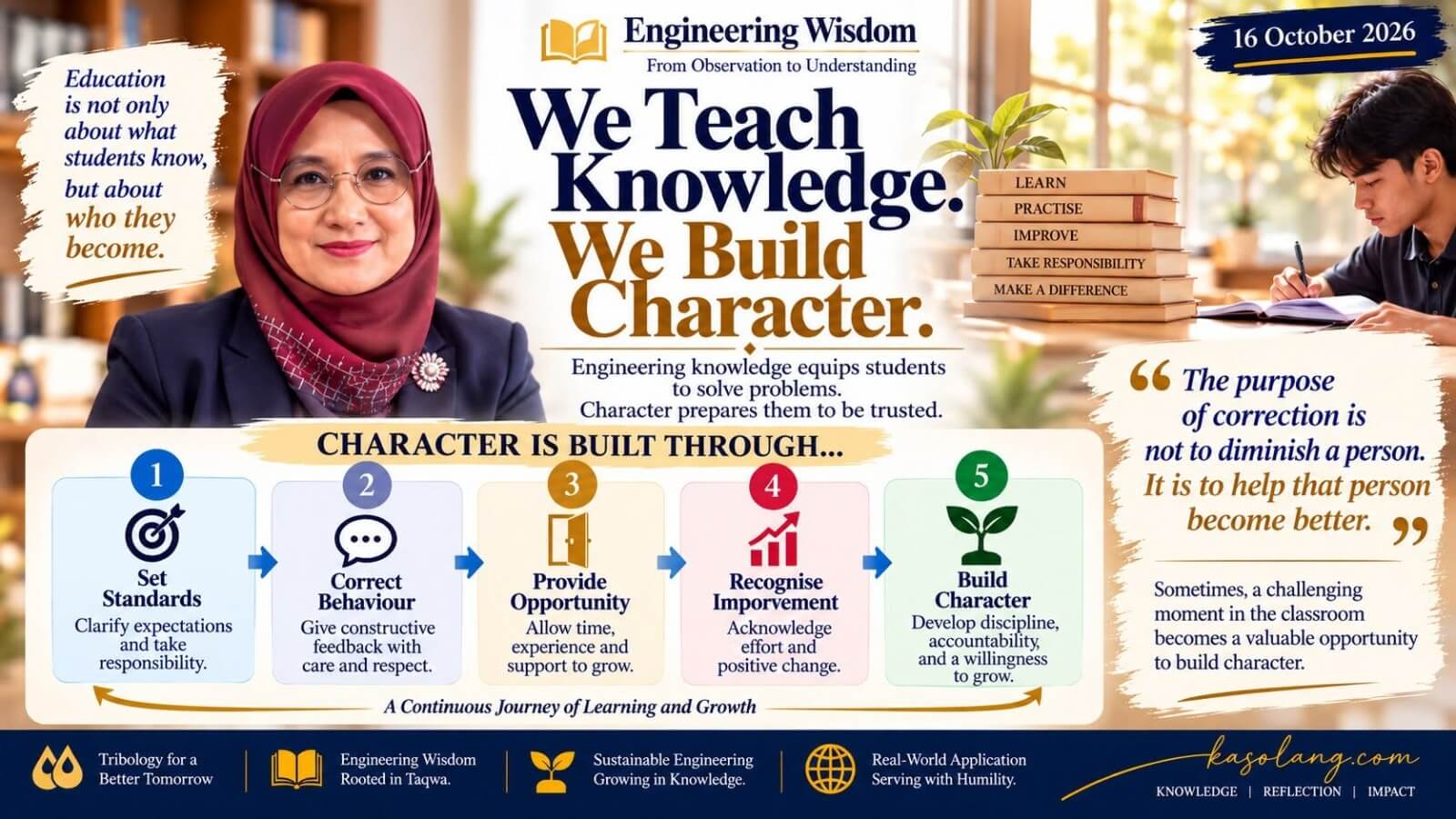
Sometimes, the most important lesson in a classroom is not found in the syllabus.
This morning, I conducted a Final Year Project 2 presentation session with my students. The purpose was straightforward: each student was expected to present their research methodology, expected results, execution plan, and deliverables towards completing their project this semester.
As an educator, I wanted to see more than a schedule. I wanted to see preparation, understanding, ownership, and commitment.
Then something unexpected happened.
When it was one student’s turn to present, he admitted that he had not prepared.
No slides. No written notes. Nothing ready to present.
I was disappointed.
I told him firmly that this was unacceptable. A presentation is not simply about standing in front of an audience and speaking. It is about respecting the responsibility entrusted to you, the time allocated, and the people who have come prepared to listen.
I reminded him that such an attitude, if carried into professional life, could reflect poorly not only on himself but also on the university that had prepared him.
But the session had to continue.
I allowed the next students to present while giving him time to prepare something.
When his turn came again, he had managed to produce a simple set of slides.
And he presented.
What did I do?
I praised him.
Yes, the same student I had reprimanded earlier.
Why?
Because although his initial attitude was unacceptable, his response to the correction deserved recognition. Within a short time, he had demonstrated that he was capable of taking action.
It was not a perfect presentation. But it was an improvement.
And improvement deserves to be acknowledged.
The Lesson Beyond the Presentation
During the session, I spoke to the students about the world awaiting them after graduation.
Imagine joining an engineering company as a junior engineer.
Your manager assigns you a project with a one-month deadline.
Instead of waiting until the final days, you organise your work, take initiative, and complete the assignment a week early — without compromising quality.
What might happen?
Your manager begins to notice your reliability. You may gradually be entrusted with greater responsibilities. Perhaps you will be considered for a management trainee programme or future leadership development.
Over time, with consistent performance, integrity, competence, and the right opportunities, your career may progress from junior engineer to senior engineer, manager, director, or even chief executive officer.
But the journey does not begin with a job title.
It begins with attitude.
How do you respond when you are given a responsibility?
Do you prepare?
Do you take ownership?
Do you respect deadlines?
Do you make excuses, or do you find ways to improve?
These are not merely workplace skills. They are elements of character.
What Is the Responsibility of an Educator?
As I reflected on the morning, I realised that the student’s lack of preparation had created an unexpected teaching opportunity.
His shortcoming became the reason I spoke to everyone about responsibility, discipline, initiative, and leadership.
What initially appeared to be a negative incident became something beneficial for the entire group.
And it reminded me of a responsibility that educators must never overlook.
We are not here merely to transfer knowledge.
We are here to help develop human beings.
Teaching engineering involves equations, experiments, analysis, design, and problem-solving. But education must also nurture honesty, discipline, accountability, respect, resilience, and the willingness to improve.
Sometimes, this requires us to be firm.
Sometimes, it requires patience.
Sometimes, it requires giving someone another chance.
And when that person makes an effort to improve, we should be equally willing to recognise it.
Correction without opportunity may discourage. Opportunity without accountability may weaken standards. Recognition of genuine improvement can encourage growth.
All three have a place in education.
The Bigger Lesson
At the end of the session, I asked all the students to redo their presentations, improve the quality of their slides, and upload the revised versions into their respective Google Drive folders.
Why?
Because completing a task is not always the same as completing it well.
I wanted them to understand that quality matters.
And I wanted them to experience improvement, not merely hear about it.
Perhaps, years from now, they will not remember every slide they presented during Final Year Project 2.
They may forget the exact questions I asked.
But I hope they will remember the importance of coming prepared, taking responsibility, responding positively to correction, and giving their best in whatever they undertake.
That would be a lesson worth carrying beyond graduation.
As for the student who came unprepared, I hope the experience becomes a turning point rather than simply an uncomfortable memory.
Because the purpose of correction is not to diminish a person.
It is to help that person become better.
And perhaps that is one of the most meaningful responsibilities entrusted to an educator.
We teach knowledge.
We build character.
Engineering Wisdom — From Observation to Understanding
KASOLANG — From Knowledge to Impact.
KASOLANG.COM
AI Disclosure: AI tools were used to support aspects of language refinement, content organisation and visual presentation. The ideas, professional insights, verification and final approval remain the responsibility of the author. Please refer to our Disclaimer & AI Disclosure for details.

Comments
Readers are warmly invited to share thoughtful reflections, questions and alternative perspectives. Comments are moderated to preserve respectful, constructive and knowledge-enriching dialogue.
Comment Policy:
- First-time comments require approval.
- Criticism and different viewpoints are welcome.
- Personal attacks, defamatory claims, advertisements and unrelated links are removed.
- Comments involving religious claims or factual corrections are checked before publication.
Leave a Reply