

Home < KNOWLEDGE < Food for Thought <
Talking with the Reader | 15 September 2026
IN BRIEF
What does it really mean for a graduate to be “industry-ready”? Should readiness mean knowing what an employer needs today, or having the foundations to learn what tomorrow will require? This reflection questions whether continually adding industry needs to an already crowded curriculum is the answer. Perhaps true readiness lies not in knowing everything on Day One, but in being able to think, adapt, act responsibly and say with confidence and humility: “I do not know this yet, but I know how to learn.”
The phrase “industry-ready graduate” has become very familiar in higher education.
We hear it in curriculum reviews, accreditation discussions, university–industry engagements and conversations about graduate employability. The intention is understandable. Universities want graduates to be relevant. Employers want graduates who can contribute. Students themselves want an education that prepares them for meaningful work.
I agree with all of that.
But during a recent presentation (ICAME2026), I found myself asking a simple question:
How ready is “industry-ready”?
Are we expecting a fresh graduate to walk into an organisation today and, almost immediately, function at full capacity?
If that is what we mean, perhaps we need to think more carefully about what education is responsible for and what should reasonably happen after a graduate enters industry.
What Is Education Trying to Develop?
Education is not simply about transferring information from lecturer to student.
We teach students how to think. And there are different levels of thinking.
We teach them how to analyse a problem, search for information, evaluate evidence, connect ideas, make decisions and communicate their reasoning.
We give them opportunities to apply knowledge and develop skills. We expose them to situations where they must work with others, make mistakes, reflect and try again.
In Outcome-Based Education (OBE), we deliberately develop students across the cognitive, psychomotor and affective domains.
So education is already doing something much larger than preparing someone to perform a particular job.
We are developing the person as well as the person’s capabilities.
INSAN Before MODAL INSAN
In the Malaysian educational context, this distinction is particularly important.
Education concerns the development of the INSAN, the human being in a holistic sense.
At the same time, education develops knowledge, skills and experiences that increase the person’s capacity to contribute.
These form what we may understand as MODAL INSAN.
Both matter.
But the order matters too.
INSAN comes before MODAL INSAN.
The graduate will certainly become part of the workforce and contribute to the economy.
But an educated person is more than an employee or a human resource.
He or she is also a member of a family, society and nation.
A citizen.
Perhaps an entrepreneur.
A leader.
Eventually, perhaps a parent, mentor or caregiver.
Employment matters greatly.
But employment is only one of the many roles that an educated human being will carry through life.
Engineering Education Is Already Carrying a Large Responsibility
Take engineering education as an example.
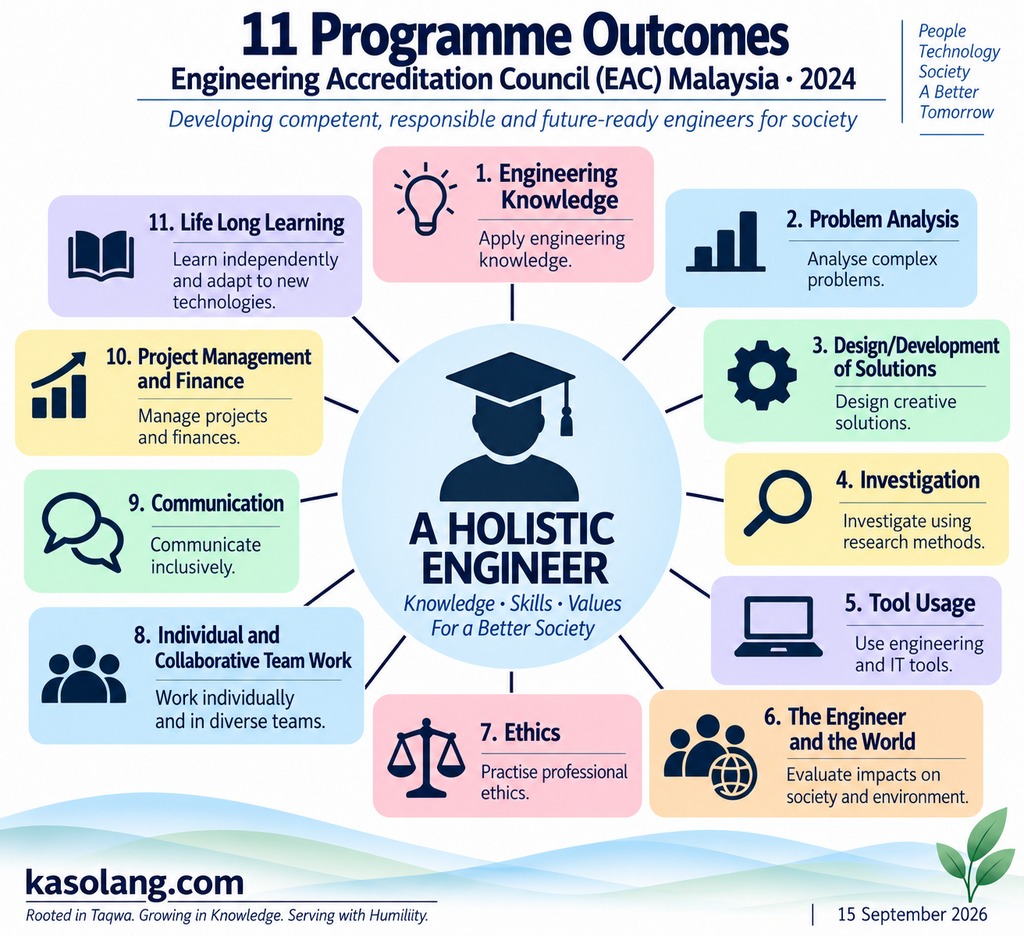
Under the Engineering Accreditation Council (EAC) Malaysia 2024 framework, engineering programmes are expected to develop graduates across 11 graduate attributes or Programme Outcomes.
These include engineering knowledge, problem analysis, design and development of solutions, investigation, modern engineering tools, the engineer and society, environment and sustainability, ethics, individual and teamwork, communication, and project management and finance.
That is already a substantial educational responsibility.
And these outcomes go far beyond technical knowledge.
We are trying to develop graduates who can think, analyse, design, investigate, communicate, work with others, behave responsibly, understand consequences and continue learning.
The intention is not to produce someone who already knows every machine, software package, operating procedure or proprietary system used by a future employer.
How could we?
Even two companies within the same industry may use different systems, technologies, processes and ways of working.
This brings me back to the meaning of readiness.
Ready for What—and for How Long?
When we say that a graduate must be “industry-ready”, perhaps we should ask a few more questions.
Ready for which industry?
Ready for which organisation?
Ready for which position?
Ready for which technology?
And perhaps most importantly:
Ready for how long?
Technology changes.
Industrial practices change.
Software changes.
Jobs themselves change.
Some of the highly specific skills we put into a curriculum today may be outdated within a few years.
Of course, universities must remain connected to industry.
Students need exposure to contemporary practices, authentic problems, appropriate technologies and the realities of professional work.
But there is a difference between being relevant to industry and attempting to produce a near-finished employee for industry.
That distinction matters.
How Much Can a Curriculum Carry?
Every additional expectation eventually looks for a place in the curriculum.
A new technology emerges.
Industry identifies another competency.
Professional bodies require another outcome.
Employers identify another skills gap.
New software becomes important.
Another certification appears useful.
Each request may be perfectly reasonable when considered on its own.
So we add.
And add.
And add.
Eventually, we may create a strange paradox:
In trying to teach students everything they might need, we may prevent them from learning deeply what they truly need.
The curriculum becomes packed.
Students move from one topic to another, one assessment to another, one activity to another.
They may be exposed to many things.
But exposure is not necessarily learning.
And learning is not necessarily formation.
Has the Learning Membekas?
There is a Malay expression that captures this beautifully:
‘Tidak membekas.’
The student encountered it.
The student completed the assignment.
Perhaps the Programme Outcome was measured.
Perhaps the required mark was achieved.
But did the learning leave a mark?
Did it change how the student thinks?
Did it strengthen judgement?
Did it develop confidence in approaching an unfamiliar problem?
Did it shape values and responsibility?
Did it increase the ability to learn independently?
That, to me, is closer to ‘kemenjadian pelajar.’
A curriculum can demonstrate coverage.
But education must seek something deeper.
Instead of continually asking:
“What else should we put into the curriculum?”
we should occasionally ask:
“What do we want to remain within the person after the curriculum has ended?”
What Happens When the Graduate Does Not Know?
Imagine a young graduate entering an engineering company.
The company uses a system she has never encountered at university.
Should we immediately conclude that her university failed to make her industry-ready?
Perhaps not.
I would be much more interested in what she does next.
Can she understand the problem?
Can she identify what she already knows?
Can she recognise what she does not know?
Can she search for reliable information?
Can she ask good questions?
Can she connect new information with her engineering foundations?
Can she learn from more experienced colleagues?
Can she make reasoned decisions?
And does she have the humility to say:
“I do not know this yet, but I know how to learn.”
I find that statement powerful.
There is humility in the first half.
I do not know this yet.
And there is confidence in the second.
But I know how to learn.
That is not necessarily an inadequately prepared graduate.
That may be a very well-educated graduate.
Industry-Ready, or Ready for Industry?
Perhaps, then, the issue is not the aspiration itself.
It is how we frame it.
An industry-ready graduate can easily be understood as someone prepared according to industry’s current requirements—a person approaching a finished product for employment.
But a graduate who is ready for industry suggests something slightly different.
This graduate has strong foundations.
The graduate can think.
Analyse.
Communicate.
Work with others.
Use appropriate engineering knowledge and tools.
Understand professional and ethical responsibility.
Connect theory with reality.
And importantly, continue learning.
Such a graduate may not know everything an employer needs on Day One.
But the graduate possesses something more enduring:
The capacity to become what the situation requires without losing the foundations of who he or she is.
Two Different Meanings of Readiness
Perhaps the distinction can be captured very simply.
Industry-ready
I have been taught what you need.
Ready for industry
I have been educated so that I can learn what I will need.
The first may prepare someone very well for today’s job.
The second may prepare someone for a working life in which jobs, technologies and challenges will continue to change.
This does not mean universities can ignore industry.
Far from it.
Universities must remain relevant.
Curricula must evolve.
Contemporary tools and technologies matter.
Industrial exposure matters.
Genuine educational gaps must be identified and addressed.
But readiness cannot mean knowing everything before employment begins.
Some learning necessarily continues after graduation.
And that leads to another conversation: what should education develop, what should industry develop, and what should they develop together?
I will leave that for the next reflection.
Perhaps We Should Stop Trying to “Finish” the Graduate
A university graduate is not a finished product.
Nor should we want one to be.
Education should give graduates sufficiently deep roots that they can continue growing when their environment changes.
So perhaps the question should not be:
“How close can universities bring students to becoming finished employees?”
A better question may be:
“How deeply can we develop the person and his or her capabilities so that the graduate is ready to enter industry, learn its context, contribute responsibly and continue growing?”
That changes the meaning of readiness.
Perhaps one of the greatest things education can give a graduate is not the confidence to say:
“I already know everything I need to know.”
But the humility and capability to say:
“I do not know this yet, but I know how to learn.”
Wallahu a‘lam bissawab.
And Allah knows best what is right.
Rooted in Taqwa. Growing in Knowledge. Serving with Humility.
AI Disclosure: AI tools were used to support aspects of language refinement, content organisation and visual presentation. The ideas, professional insights, verification and final approval remain the responsibility of the author. Please refer to our Disclaimer & AI Disclosure for details.

Comments
Readers are warmly invited to share thoughtful reflections, questions and alternative perspectives. Comments are moderated to preserve respectful, constructive and knowledge-enriching dialogue.
Comment Policy:
- First-time comments require approval.
- Criticism and different viewpoints are welcome.
- Personal attacks, defamatory claims, advertisements and unrelated links are removed.
- Comments involving religious claims or factual corrections are checked before publication.
Leave a Reply